
About
Dr. Tobias Wiggins is an associate professor of Women’s and Gender Studies at Athabasca University with a specialization in transgender issues, arts-based research, and psychoanalysis.

Academic Writing & Media
-
by Tobias Wiggins, Jess A. Joseph, Tavi Bishop
Studies in Gender and SexualityThis article introduces a special issue on trans lives within psychoanalysis, theorizing two interlinked concepts: transpectres, the caricatured figures that haunt and produce gendered life; and cisteria, a defensive formation that organizes contemporary anti-trans panics. Drawing on histories of hysteria within and beyond psychoanalysis, it relocates pathology away from trans subjectivity, toward ciscentric psychology and its associated structures of power. The analysis traces how state security regimes—such as the trope of the “trans terrorist” as “Nihilistic Violent Extremist”—consolidate authoritarian control while generating lethal conditions for trans life. The authors develop “threat psychoanalysis” as a trans method, reading cisteria across intrapsychic, relational, and sociopolitical registers while refusing respectability politics or demands to prove trans innocence. The article concludes by introducing the special issue’s contributors, whose clinical, theoretical, and creative interventions co-imagine a shared transpsychoanalytic experiment in play, feeling, critique, and shared world-making.
-
By Tobias Wiggins
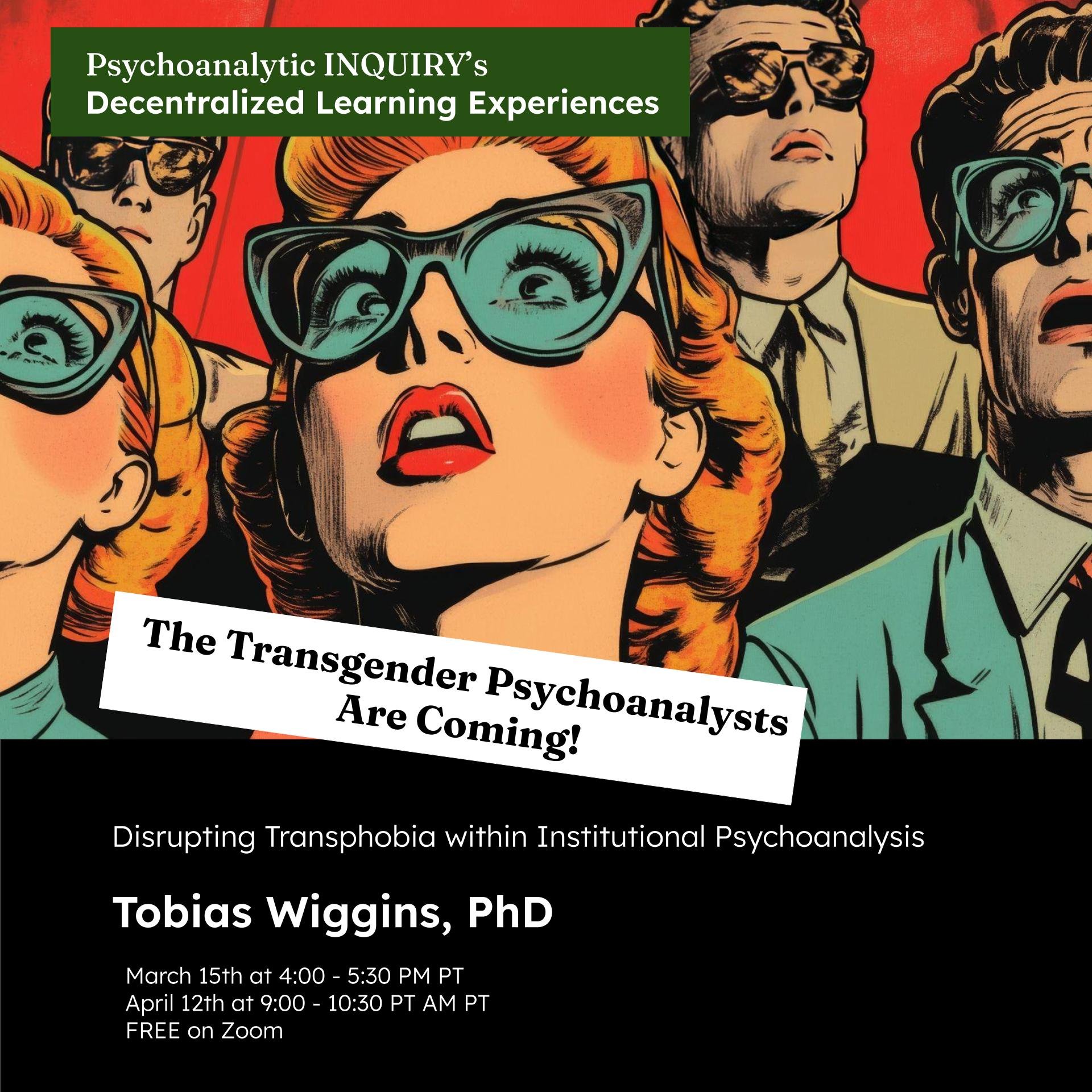
in The Queerness of Psychoanalysis: From Freud and Lacan to Laplanche and BeyondTo “gird your loins” is a common idiom with a comical edge, a metonymic and thus anticipatory expression. It is both a gendered and sexed declaration, meant to warn of upcoming difficulty or strenuous undertaking. In this chapter, I explore the institution of clinical psychoanalysis and its resolute loingirding against transgender people, despite some of its most fundamentally queer and gender nonconforming premises. In so doing, I contribute to a growing body of scholarship that challenges psychoanalysis’ fundamentally destructive quotidian clinical transphobia. In particular, I address the under-considered issue of transgender people’s systemic exclusion from the status of “psychoanalyst.” The institution’s girding against trans subjects has, thus far, been primarily disputed by cisgender psychoanalysts. Their efforts have been instrumental in a setting where it has been otherwise impossible for transgender people to be heard. However, as these disruptions of long-worn norms begin to take hold and rouse change, the most rudimentary move of meaningful professional inclusion has simply not taken place. As Wark (2023) writes her call for reparations: “Dear Psychoanalysts, I’m going to assume nearly all of you are cis, even though you may have trans patients. There are so few trans analysts. And why is that?” This talk provides an overview of the state of the profession, charting the lasting effects of a shared psychoanalytic cis-tuation, highlighting how trans-led interventions are restricted, peripheralized, or split-off as “not really psychoanalytic.” Ultimately, I argue that transgender people’s biggest asset is their still unfaltering irreconcilability with clinical psychoanalysis in its present form.
-
By Tobias Wiggins
in Gender-Affirming Psychiatric Care for Transgender and Gender Diverse PeopleAs the previously sanctioned pathologization of gender non-conforming identities is rapidly challenged within medical models, many transgender people are newly seeking out affirming mental health care. In turn, guidelines for trans competent psychotherapeutic practice are being developed to help practitioners best respect client self-determination, to better understand the multi-facets of gender identity, and to identify challenges to effective treatment. Yet many of these resources have overlooked the identification and management of what emerging scholarship has called transphobic countertransference (TCT), referring to the ways in which a clinician’s unconscious prejudice can be felt, and potentially acted out, within the consulting room. This chapter normalizes two underdiscussed elements of clinical work with 2TNG populations: first, the undeniable presence of transphobia within the consulting room; and relatedly, the impact and uses of TCT in psychotherapy of any orientation. Clinical transphobia is framed here as an “unresolved issue” that gains utility only through its identification. Borrowing from Hansbury’s (2017) foundation, I define psychotic TCT as a set of infantile affective distortions, and contribute two additional common forms of TCT to this conceptualization: perverse TCT, relating to the internalized law and omnipotence of diagnosis; and neurotic TCT, in which the clinician’s previously held gendered meanings and social learning materialize. Ultimately, this investigation aims to help cisgender therapists better recognize their own distinct and heterogeneous reactions to 2TNG gender difference in the consulting room and, further, to curtail potential enactments.
-
By Tobias Wiggins
in Transgender Studies QuarterlyTransgender people have long been associated with sexual perversion. For example, many early versions of the Diagnostic and Statistical Manual of Mental Disorders (DSM) infamously categorized any gender variance as sexual deviance or paraphilia. This article therefore investigates the taxonomical movement away from the transgender subject as perverse toward the current diagnosis of gender dysphoria, which instead consolidates the transgender subject as distressed and suffering. Through an unconventional use of psychoanalytic theories of perversion, I argue that DSM-5’s new diagnosis criteria work defensively, functioning as an antidote to the clinician's anxiety in the face of difference. When separated from stereotypical acts and identities, perversion proves to be quite valuable in understanding clinical transphobia. In particular, Freud's writings on fetishism and disavowal reveal some of the unconscious roles at play in the repeated medicalization of trans people and the restricting of transition-related resources. Through the donning of a fetish object, disavowal acts to ignore an upsetting reality while the traumatic truth remains intact. An analysis of Chase Joynt's video installation, Resisterectomy, provides grounded narratives of gendered surgery and illness that disrupt anticipated affects, temporalities, and curative measures.